Thursday, November 30, 2006

There is always lots of buzz in Christian circles about Christmas.

'You know, it really is a pagan holiday'.

'It's actually just the celebration of capitalistic greed.'

'More people commit suicide at Christmas than at any other time of the year.'

'Jesus was really born in April.'

'We need to be more sensitive to other faith groups during this Holiday Season.'

Or my personal favourite, 'Let's put the Christ back in Christmas!'
Forget about it. Relax. Enjoy.

If you want added meaning, then use this time to . . .
. . . remember those in need . . . spend time with your family . . . give a boost to the economy by racking up your VISA . . . wish someone happy Hanukkah . . . reflect on the cosmic implications of the birth of Jesus . . . take a break from South Beach . . . sleep.

There is nothing inherantly sacred about Christmas, so don't worry about searching for the 'real meaning' of the holiday. Give it meaning.

For me this year, Christmas means seeing my kids get caught up in the magic of the lights and the snow and the expectation of gifts. For me it means drinking eggnog lattes and having afternoon naps after large meals. For me it means finding the time and the energy to dream new dreams for Southpoint. For me it means confronting my apathy toward people in need.

What meaning will you give the holiday?


Tuesday, July 11, 2006

"A good traveler has no fixed plan, and is not intent on arriving"
Lao Tzu, The Way of Life.

Riding a motorbike has taught me how to live. I pray more. I pay more attention to my surroundings. I focus on the road ahead. And I plan trips based on the road and not the destination.

Our latest bike journey took us through Aschroft, Nakusp and Rock Creek. Not exactly top holiday destinations. But the roads in between . . .


I have this book that lists the top 180 motorcycle roads in BC. The roads are ranked according to their twistiness, engineering, pavement quality, remoteness and various other features. Whenever we get the opportunity to take off on the bike, we first consult this book. And then we plan our journey around the roads we want to take. Destinations are simply rest stops on the journey.

This last trip, during breakfast in Aschroft, we discovered an alternate route to Kamloops that would take us off the beaten path of HWY 1. We changed our course entirely and spent several hours on one of BC's best roads and only saw about three other vehicles!

Detours are part of the journey. And, as someone brilliant once said, "The journey is the thing."


In a world that sometimes pressures us to have a five year plan for everything, it's nice to get on a bike and plan for the journey and not the destination.

"Do not worry about tomorrow, for tomorrow will worry about itself." Jesus

Thursday, May 25, 2006


The Da Vinci Code movie was something of a non-event. The movie was enjoyable and even entertaining, but after all the hype it didn't seem particularly controversial or enlightening. As my wife commented, it was a great scavenger hunt!

If there is something deeper in the Code, perhaps it has to do with the question, 'how do we know the truth?'

More specifically, how do we know the truth about Jesus?

The attack, if there is one, seems directed at the writings of the New Testament. Doubt is cast over the creation of this particular selection of writings with the supposed suppression of others. The conclusion that we are meant to draw is that the suppressed material contains THE true picture of Jesus. A picture that threatens the male dominated authority of the church.

But, perhaps those other writings were suppressed or rejected for a reason. Suppression does not convey virtue. It does not necessarily infer authenticity.

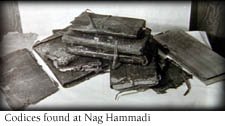
The Gospel of Thomas is one document quoted in the Code. It forms part of the collection of over fifty ancient texts known as the Nag Hammadi discovered in Egypt in 1945. This is not the first time it has provided the mysterious backdrop for a movie. The 1999 movie Stigmata revolves around the alleged cover up of this document by the Roman Catholic Church because of its emphasis on individual access to God outside of the organized structures and sacraments of the church.

According to the Code, this writing was rejected from the Canon (rule or standard) of the New Testament, along with other gnostic gospels, at the Council of Nicaea convened by Constantine in 325 AD. As Sir Teabing states in the novel, "The fundamental irony of Christianity [is that] the Bible, as we know it today, was collated by the pagan Roman Emperor Constantine the Great" (p.231)

In truth, the selection process for accepted Christian writings was much more organic and began long before the Emperor Constantine and the Council of Nicaea. In fact, the council of Nicaea had nothing to do with the canon of scripture, as alleged in the Code. Nicaea was about doctrine. Specifically, the challenge to the divinity of Jesus.

The first list of authoritative Christian writings dates back to 170 AD and contains 22 of our current 27 accepted New Testament writings.

By the end of the 3rd century, Eusebius, bishop of Caesarea in Palestine, had compiled a list of 22 books with an additional five noted as 'disputed'. Together, they form the list of our current NT.

It was at the North African Council of Carthage (397 AD) that this full list was ratified by the assembled bishops and passed on to Rome for confirmation.

Very little mention is made of the 'Nag Hammadi' writings. Probably because most of them had not yet been written by the time of the first list.

No suppression. No cover up. Really a non-event at the end of a long, natural journey.

Ultimately, however, these collected writings are not the final authority in all matters of faith and practice. Unfortunately, we've been taught that they are. That's why many of us get bent out of shape when the list is challenged. In evangelical circles, this collection of writings has been raised to a status close to divinity. We almost worship this collection . . .

Yet, great historical figures from Augustine to Martin Luther have questioned and wrestled with 'the list'.

It may be helpful to understand that there is only one authority over the church - Jesus himself! The scriptures and writings testify to him. They are a reliable way of knowing the truth about Jesus. But we have access to him even beyond these writings. Don't we? The church existed, and even thrived, for four hundred years without an 'approved' collection. God's revelation extends beyond the written page, even to natural and mystical dimensions.

After all, the truth is out there. And in here. And all around us.

Or am I revealing gnostic tendencies?

Friday, May 12, 2006


Perhaps I should have some groovy podcast on this blog so that my Sunday sermons could be made available to those who missed the worship gathering?

Not a bad idea. Apart from the fact that I would then have one more thing to add to my list!

I actually have significant concerns about recording sermons. While recognizing the potential benefit, I also feel that something is lost in the recording process.

Marshall McLuhan is attributed with the dictum, 'the medium is the message'. My understanding of the statement is that we can't simply take a truth and communicate it through various means without altering the truth itself.

'Our tools shape us' is another way of thinking about this. The T.V. is a tool for communication. It also has shaped an entire generation. The car. The computer. The internet. Think about how these tools, used by us to shape our world, have, in turn, shaped us.

No, really, take some time to think about it . . .

The medium is the message. When information about an event makes it to the evening news it becomes entertainment. The tool used to communicate the information (t.v. newscast) has also shaped the truth about the event.

God's word communicated through a person is shaped by the preacher. Preaching is 'truth through personality'.

But the preacher is not the only person in the room. The listeners also shape the truth. We alter that which we observe simply by our presence. There is no such thing as an objective listener.

The Spirit of Jesus present in the body of Jesus (aka church) also adds a dynamic that shapes the truth.

And so the message delivered from the Word by the preacher in the presence of the Spirit and in participation with the congregation is a truth-event that cannot be transmitted with accuracy through electronic medium.

If it is, the truth-event is then reduced to entertainment consumed by an individual.

Stay tune next week for my rant on note taking during sermons . . .

And come to worship on Sunday prepared to shape the message!

Friday, May 05, 2006


These are my kids and I love them! Most of the time I even like being with them. Especially on the happy days when ice cream solves all problems and relieves all tension.

But I often worry about them. What kind of world did we bring them into? How will they cope with all the crap that they will face in their life? Will they grow up to love God and follow in the way of Jesus?

What is my responsibility to direct them on that path? Is Sunday School the solution to moral instruction for my kids?

Sunday Schools started appearing in England around 1780. They were created to provide basic instruction to poor, working class people on their free day. They were not age or sex specific. They often used the Bible as a text, but the focus was not on Bible instruction.

The focus was on helping people on the margins of society to gain skills for life.

Bible instruction was seen as the responsibility of the parents.

It always has been that way. "Fix these words of mine in your hearts and minds; tie them as symbols on your hands and bind them on your foreheads. Teach them to your children, talking about them when you sit at home and when you walk along the road, when you lie down and when you get up." (Deuteronomy 11:18,19)

So, what is Sunday School for today? I think that we could agree that basic instruction for the poor is not the goal. Perhaps religious knowledge is, especially since this component is largely absent from our school system.

But what about parental involvement?

I love it when other safe and caring adults take an active interest in the lives of my children. As the well used proverb states, "It takes the whole village to raise the child."

But am I depending on someone else for the spiritual formation of my kids during one hour on Sunday morning? Do I simply use this 'service' to get some me-worship time?

Perhaps it is time for the church to shift its focus from teaching children to equipping parents to teach their own kids.

And it's time for me to show my kids the way of Jesus. When I'm asleep, awake, at work and play - even while eating ice cream at McD's.

Friday, April 28, 2006

My friend Laura recently gave me a great image of the church - a wildflower garden. Not straight and neat and cultivated and orderly and uniform. But rather its beauty lies in its diversity, randomness and lack of intense cultivation. There is even room for a few weeds in this garden.

I think this is what I have in mind when I talk about the need for our Church at Southpoint to be 'organic'.

Organic is a way of growing things. A way that doesn't force production or introduce foreign substances to the growing environment. Organic growth modifies our perception of success. We're not looking for the perfect size and shape. We're not driven by numbers and high yields. We're not seeking tight uniformity to a predetermined standard of excellence.

Instead, we're pursuing health and wholeness in an environment that encourages the most natural forms of growth and beauty possible.

Organic church causes us to look at the way we worship, reach out, make decisions, form community.

This year, it has meant doing away with Robert's Rules of Order. It has meant canceling all our plug-and-play small groups including Alpha. It has meant running none of the usual programs associated with the suburban church. It has meant no advertising.

Instead, we gather around the table in a home mid-week for a shared meal and guided conversation (and the occasional episode of Amazing Race!). Sunday worship centers around the hospitality of God offered in Jesus and imaged in the cup and the bread. People are discovering natural ways to serve their neighbours, friends, co-workers and families as ambassadors for Jesus.

Artists have painted. Singers have sung. Teachers have taught. People have shared their stories. Kids have filled our meeting space with all kinds of noises and have even shared in communion! A diversity of age, race, occupations and incomes have gathered to form a wildflower garden.

This isn't a good place for people who like control and order, procedure and protocol. It's not a good place for people who like to do a lot of weeding. But it is becoming a place of natural beauty and I am glad to be gardened together by the same Spirit.